
Hanging wallpaper takes more preparation than skill. Three things decide how it turns out: the condition of the wall, a perfectly plumb first panel, and using the right method for your material. This guide covers the tools, the wall prep and step-by-step instructions for each of our three materials: Peel & Stick Fabric Canvas, Non-Woven Wallpaper and the Seamless Fabric Wall Mural.
Know Your Material First
The material you pick at checkout decides how the wallpaper goes up. Here is the short version:
| Material | How it goes up | Best for |
|---|---|---|
| Peel & Stick Fabric Canvas | Peel off the backing and press it on; no glue. Comes in 40-inch (100-105 cm) panels that can be lifted and repositioned while you install. | Renters and quick room refreshes |
| Non-Woven Wallpaper | Paste the wall, the paper stays dry. Comes in 40-inch (100-105 cm) panels. | First-timers and high-traffic rooms |
| Seamless Fabric Wall Mural | One piece made to the size of your wall, hung with wallpaper glue. It is large and heavy, so plan on two people. | Statement walls with no joins at all |
For a deeper look at how the three compare, read our peel and stick wallpaper guide.
Tools You Will Need
- Wallpaper paste, a paint roller and a small brush (for Non-Woven and Seamless Fabric)
- A plastic smoother or wallpaper brush
- A utility knife and plenty of spare blades
- A 6-inch putty knife or wide drywall knife to guide your cuts
- A level, plumb line or laser level
- Tape measure and pencil
- A bucket of clean water and a sponge
- A step ladder and drop cloth
Small thing, big difference: snap off a fresh blade section every two or three cuts. A dull blade drags and tears damp paper instead of cutting it, and it is the most common reason edges look ragged.
Prepare the Wall
Wallpaper does not hide a wall; it shows it off, flaws included. Before you start, the wall should be dry, smooth, clean and free of dust.
- Fresh paint: wait at least 2 to 3 weeks for new paint to cure. Paper hung on uncured paint can bubble or lift.
- Holes and cracks: fill them, sand smooth once dry and wipe off the dust.
- Old wallpaper: removing it is usually the better choice. Our guide on whether you can put wallpaper over wallpaper explains the few cases where covering it works.
- For peel and stick: the wall needs to be smooth. Heavy textures like orange peel or knockdown, and Teflon or washable paints, do not hold the adhesive well; choose Non-Woven for walls like that.
- Damp walls: never hang wallpaper over moisture or mold. Fix the cause first.
- Outlets and switches: turn off the power to that wall and remove the cover plates.
How to Install Peel and Stick Wallpaper
This is the fastest way to put up a mural, with no paste, bucket or sponge. The canvas has a strong adhesive, so the trick is to go slowly rather than slap a whole panel on at once.
- Lay out the panels. Unroll them on a clean floor in order and check how the design joins. Knowing which panel goes where is far easier on the floor than on a ladder.
- Draw a plumb line. Do not start from the corner; corners are rarely square. Measure one panel width minus half an inch from the left edge of the wall and draw a vertical line with a level from ceiling to floor.
- Start the first panel. Peel back the top 4 to 6 inches of backing and fold it over. Line the edge up with your pencil line, leave a little extra at the ceiling and smooth the top section down.
- Work your way down. Pull the backing down slowly with one hand while you sweep the smoother from the center out to the edges with the other. Never pull the whole backing off first; the panel will stick to itself.
- Fix mistakes right away. If the panel starts to drift off the line, stop, lift it gently and lay it again.
- Butt the next panel. Place panel two edge to edge with the first, without overlapping, and match the design before smoothing it down.
- Trim. Hold a putty knife tight against the ceiling and baseboard and run a sharp blade along it.
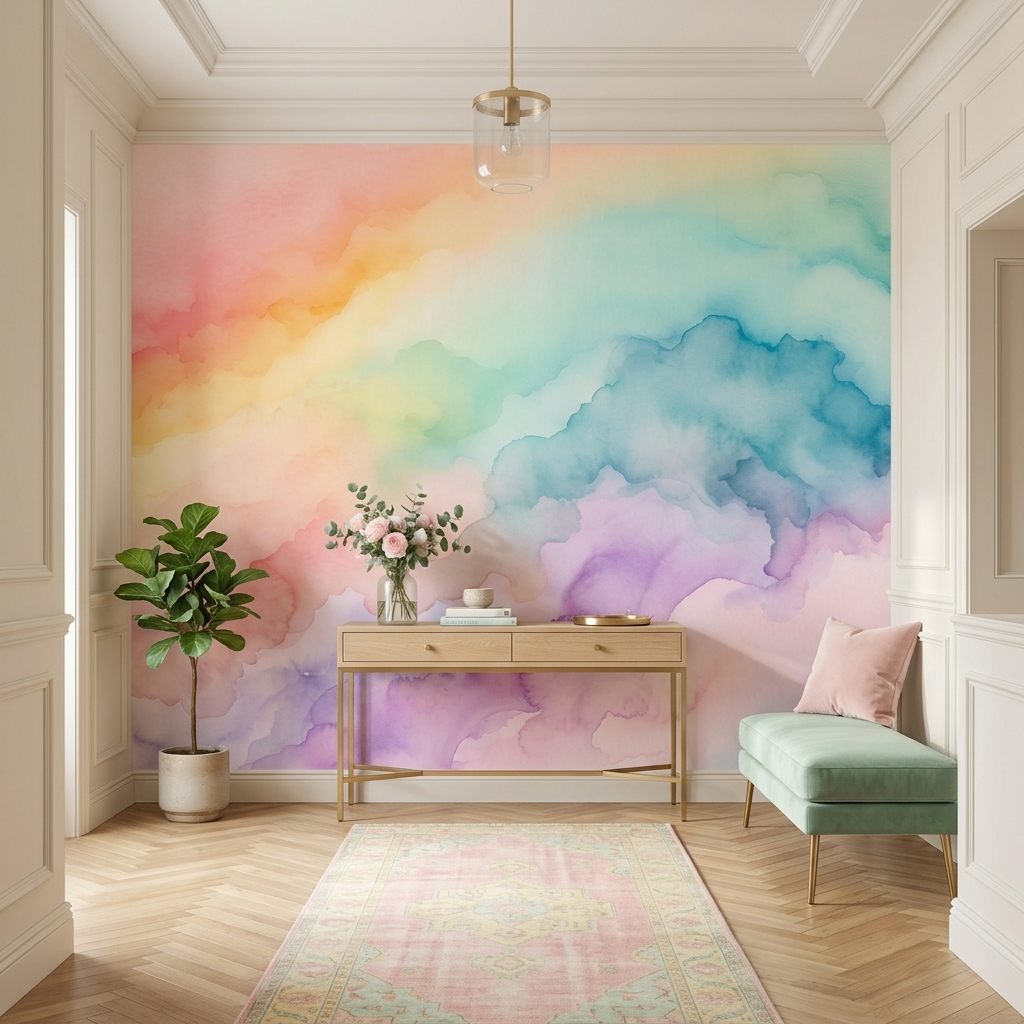
A kids room in an afternoon
For kids room designs like these pastel rainbow clouds, Peel & Stick Fabric Canvas is the practical choice: no paste, no buckets, and the room can be done in an afternoon. When the theme changes a few years later, the panels peel away with no sticky residue, as long as the wall underneath is smooth and sound.
How to Hang Non-Woven Wallpaper
Non-Woven is a paste-the-wall paper: the glue goes on the wall, not on the paper, so there is no soaking or booking. That makes it the easiest traditional wallpaper to hang if you have never done it before.
- Lay out the panels and draw your plumb line exactly as described above.
- Mix the paste following the instructions on the package and let it stand for the time given. It should be smooth, with no lumps.
- Paste the wall. Roll an even coat over the area the first panel will cover, plus 2 to 4 inches on each side. Finish the edges with a brush.
- Hang the dry panel. Hold it at the top, leave 1 to 2 inches of overlap at the ceiling, line the edge up with your plumb line and let it fall into place. While the paste is wet you can slide it a little to adjust.
- Smooth out air. Work from the center out and from top to bottom, pushing bubbles to the edge instead of trapping them in the middle.
- Next panel. Paste the next section of wall and butt the second panel tight against the first, matching the pattern. Do not overlap the seams.
- Trim the excess at the ceiling and baseboard with a putty knife and a sharp blade.
- Wipe the seams. Remove any paste that squeezes out with a damp sponge right away; dried paste can leave a shiny mark.
- Outlets. Hang the paper right over the box, cut a small X over the opening, trim to the edge of the box and screw the cover plate back on.
Let the room dry for a day without drafts. If a heating or AC vent blows straight onto the wall, close it for that time; paper that dries too fast can open at the seams.

When the pattern crosses a seam
On designs like this peacock with flowering branches on mustard, branches run from one panel into the next, so the seams need care. When you place the second panel, line up the tip of one branch first and then let the rest of the panel fall. Getting one point right gets the whole length right.
How to Hang a Seamless Fabric Wall Mural
The Seamless Fabric Wall Mural is printed as one piece to the size of your wall, so there is no second panel to line up. The challenge is size: a mural for a 10 to 13 foot wall is heavy and needs two people.
- Prepare the wall the same way and draw a plumb line down the center.
- Prepare and apply the adhesive following the instructions that come with your wallpaper glue.
- One person supports the roll from below while the other places the top edge, leaving 1 to 2 inches at the ceiling, and lines up the center with the plumb line.
- Smooth from the center outward to both sides. The woven fabric does not stretch easily, so wrinkles can be worked out to the edge if you take your time.
- Trim the ceiling, baseboard and side edges with a putty knife and a sharp blade.
For very large walls, high ceilings and stairwells, we suggest hiring a professional installer for this material.
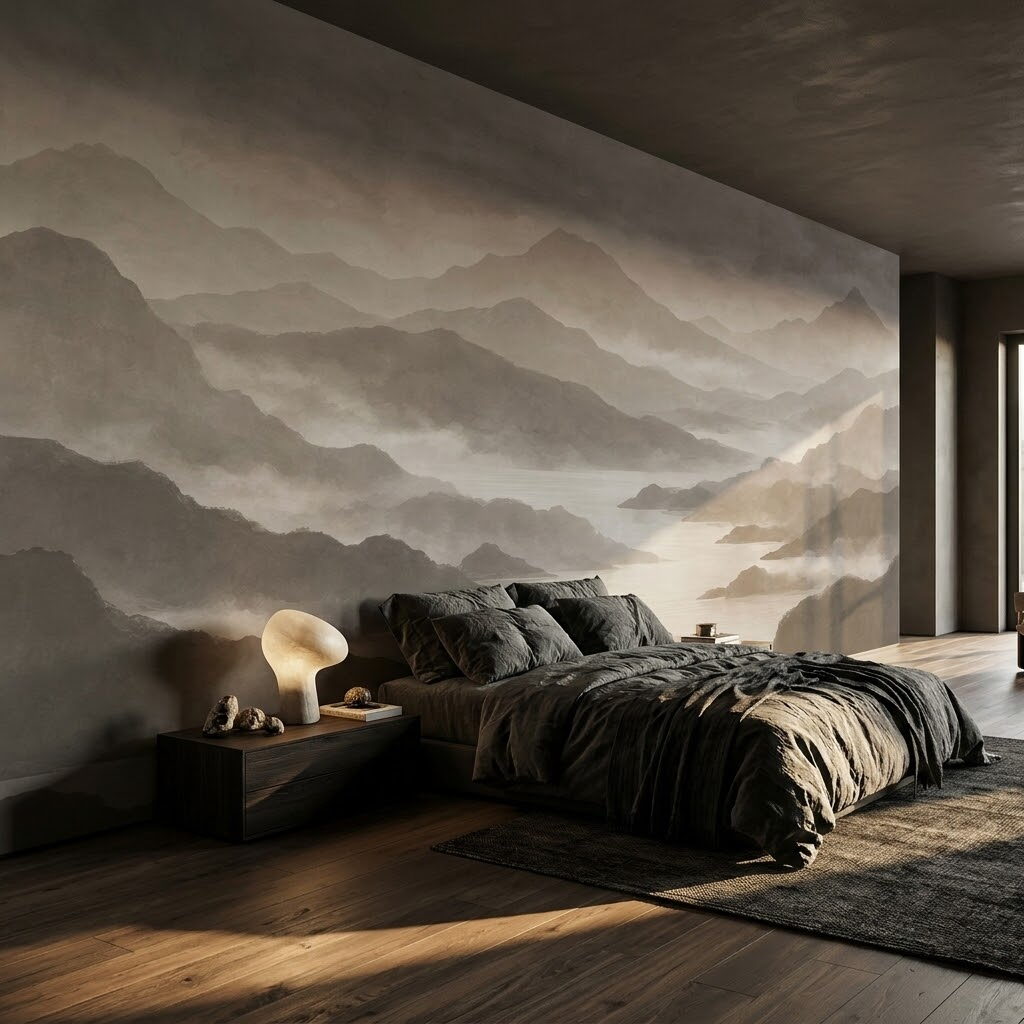
Keep the horizon level
With wide landscapes like these gray misty mountains, a first panel that is a few millimeters off plumb turns into a visibly tilted horizon by the far end of the wall. On landscape designs, always draw your guide line with a level instead of judging by eye.
Common Mistakes to Avoid
- Starting in the corner: if the corner is out of square, every panel after it will be too.
- Pasting Non-Woven paper: the paste goes on the wall. Wetting the paper is unnecessary and can make the edges lift.
- Too much paste: it squeezes out of the seams and marks the surface. A thin, even coat is enough.
- A dull blade: it tears instead of cutting. Change it often.
- Hanging on fresh paint: wait 2 to 3 weeks.
- Peeling all the backing at once: a peel and stick panel will fold onto itself and is hard to rescue.
How Long Does It Take, and Can I Do It Myself?
Most of our customers hang Peel & Stick Fabric Canvas and Non-Woven Wallpaper themselves. A single 10 to 13 foot wall usually takes two first-timers two to three hours, and about half of that is preparation. The Seamless Fabric Wall Mural, high ceilings and stairwells are better left to a pro. You can see walls our customers hung themselves on our installation photos page.
If you have not ordered yet, start with how to measure your wall; an accurate measurement is half the job. And when it is time for a change, here is how to remove peel and stick wallpaper without damaging the paint. Not sure which material suits your wall? Send us a photo and we will help you choose.
Frequently Asked Questions
Do you put wallpaper paste on the wall or on the paper?
For Non-Woven Wallpaper the paste goes on the wall and the paper stays dry. For the Seamless Fabric Wall Mural, follow the instructions that come with your wallpaper glue. Peel & Stick Fabric Canvas needs no paste at all.
Do I need to prime the wall before hanging wallpaper?
On a sound, smoothly painted wall it is usually not necessary. On porous surfaces like new drywall or fresh plaster, or over patched areas, a primer helps the adhesive grip evenly.
How long does wallpaper take to dry?
Pasted wallpaper usually needs 24 to 48 hours to fully set. Keep the room free of drafts and keep heating or AC vents from blowing directly on the wall during that time.
Can you put peel and stick wallpaper on textured walls?
Not on heavy textures. Orange peel, knockdown and other pronounced textures, as well as Teflon or washable paints, keep the adhesive from bonding properly. For those walls, choose Non-Woven Wallpaper.
Can you hang wallpaper over tile?
We do not recommend it. Grout lines show through over time and adhesion on glossy tile is weak. If you want to change a tiled wall, cover the area above the tile instead.

